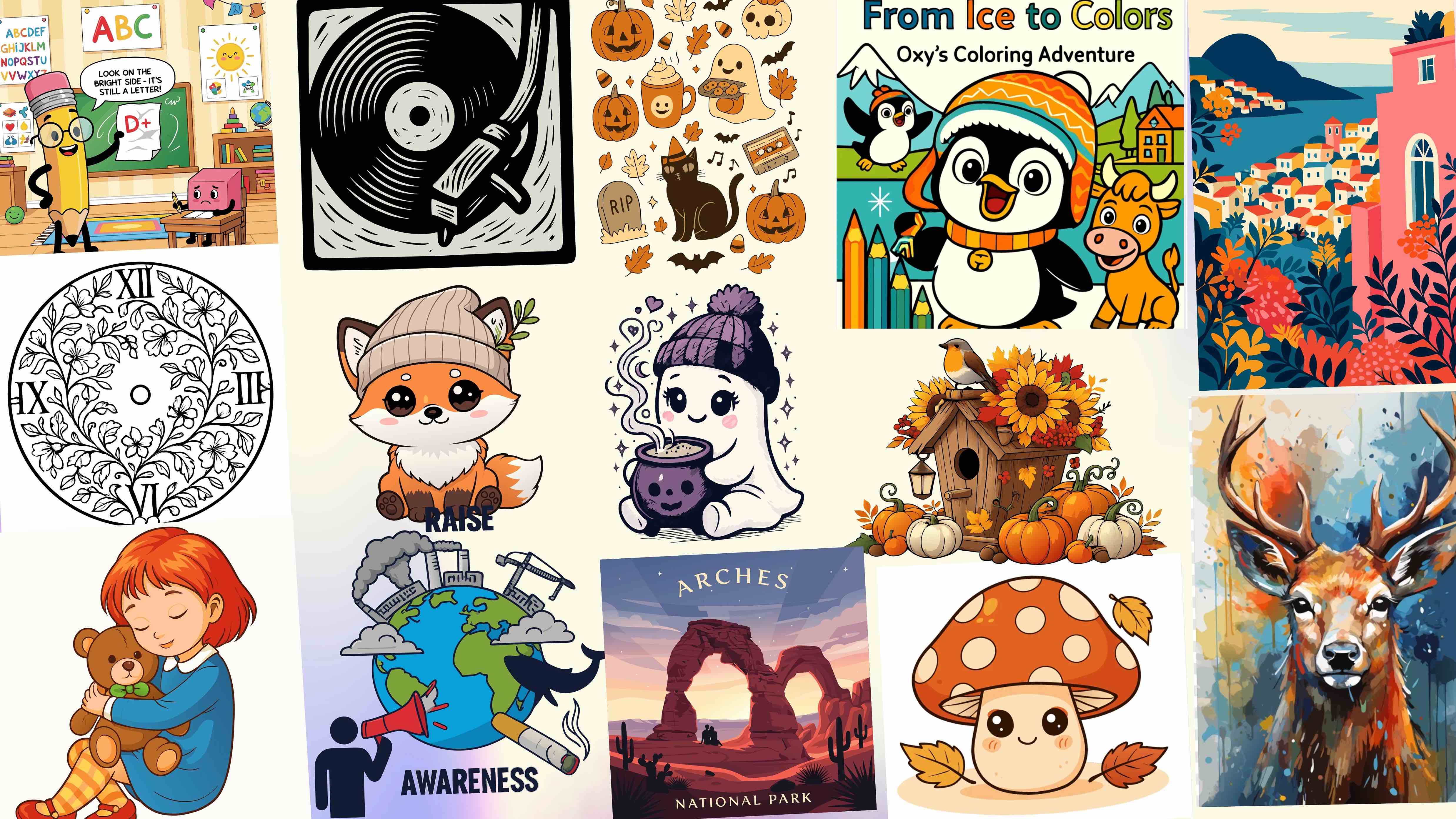
Visualize Product Features: A Strategic Guide to Icons, Graphics, and Conversion

You have a powerful solution. Your features are robust. But you've described them in dense paragraphs, and as a result, your bounce rate is climbing. When a visitor lands on your page and sees a wall of text under "Features," their brain immediately categorizes it as "work." They scroll past it, missing the value you worked so hard to build.
According to the Nielsen Norman Group, users typically read only 20-28% of words on a web page during an average visit, and scanning is the norm rather than in-depth reading. This behavior is why text-heavy feature sections fail to communicate value.
The fix isn't just "adding pictures." It's a strategic overhaul of how you visualize product features. A single icon communicates "security" faster than a sentence about encryption. An infographic showing your product's performance numbers lands harder than a paragraph of stats. A custom illustration of your workflow tells the story before the visitor has finished scrolling.
Research from the Massachusetts Institute of Technology (MIT) shows that the human brain can process entire images in as little as 13 milliseconds—far faster than the 200-300 milliseconds required to read a single word. This visual processing advantage explains why icons and graphics create immediate comprehension.
The hard part used to be making those visuals. You'd hire a designer, wait for revisions, and pay $500 for a set of icons that might not match your brand. Or you'd grab generic stock icons that look like every other SaaS landing page. A study by Stanford University's Web Credibility Project found that low-quality or generic visuals significantly damage a site's perceived trustworthiness—users judge a company by the quality of its presentation.
That's changed. You can now generate custom vector icons, illustrations, infographics, and graphics with AI, directly from text descriptions, and get SVG output you can drop straight into your site. This guide combines visual psychology with practical tooling—specifically focusing on vector workflows using AI—to help you build pages that convert.
The Psychology of Visual Processing
Before we discuss the "how," we must address the "why." Why do icons and graphics outperform text?
| Cognitive Factor | Text Processing | Visual Processing | Impact on Conversion |
|---|---|---|---|
| Speed | 200-300ms per word | 50ms for whole image | Faster comprehension reduces bounce rate |
| Cognitive Load | High (decoding symbols) | Low (pattern recognition) | Easier scanning leads to longer dwell time |
| Memory Retention | 10-20% recall after 3 days | 65% recall when paired with relevant image | Better recall = higher brand consideration |
The 50-Millisecond Judgment: Users form an opinion about your website in 50 milliseconds. Text cannot be processed that fast; visual patterns can. A well-designed icon grid tells the user, "This is a professional, modern tool," before they read a single word.
There's also a measurable conversion impact. Landing pages with custom visual elements consistently outperform text-only layouts in A/B tests. Generic stock imagery doesn't produce the same effect—users have developed blindness to overused stock icons. Custom visuals, even simple ones, signal that a company cares about its product.
Understanding this psychology is the first step. The second is executing it with the right tools.
Types of Visuals That Showcase Product Features Effectively
Not all visuals serve the same purpose on a product page. The most effective feature sections combine multiple visual types, each chosen for what it communicates best. Here are the five categories that cover the majority of use cases.
1. Feature Icons
Feature icons are the foundational visual element of any product page. They sit alongside feature headings and provide instant visual categorization. Effective feature icons share a consistent style (line weight, corner radius, color palette) and work at small sizes (24px–48px).
Icons serve as cognitive shortcuts. A shield icon next to a "Security" heading communicates the concept before the user reads a single word. A speed gauge icon paired with "Performance" triggers an instant association. This pre-processing effect means users arrive at your feature descriptions already understanding the category, so they can focus on specifics rather than parsing what each section is about.
2. Infographics and Data Visualizations
When a product feature involves a workflow, comparison, or numerical data, an infographic communicates more effectively than any paragraph. Process diagrams show how a feature works step-by-step. Comparison charts demonstrate advantages. Data visualizations make performance metrics tangible.
SVG is well-suited for infographics because text within SVG elements remains selectable and accessible, unlike rasterized images.
3. Hero Illustrations and Graphics
Hero illustrations are larger-format visuals that anchor a section or page. They set the visual tone, communicate brand personality, and give product pages a distinctive identity that stock photography can't match.
4. Product Screenshots with Annotated Overlays
Screenshots prove that a feature exists and show what it looks like in practice. But raw screenshots without context leave users guessing about what to notice. Annotated screenshots—with callout arrows, numbered labels, and highlighted regions—direct attention to the specific UI elements that matter. The most effective approach combines a raster screenshot with SVG annotation overlays. The screenshot provides authenticity, while the SVG overlays provide clarity.
5. Animated SVG Icons and Micro-interactions
Static icons communicate a category. Animated icons communicate action. A subtle hover animation—a gear that rotates, a chart that fills, an envelope that opens—adds interactivity that makes feature sections feel alive without the performance cost of video or GIF.
SVG animations can use CSS @keyframes, JavaScript libraries, or the native <animate> element. The key is restraint: micro-interactions should be subtle (200-400ms), purposeful, and performant.
Traditional Approaches vs. AI-Powered Workflows
Teams have historically relied on four approaches to create product feature visuals, each with distinct tradeoffs. AI-powered generation changes the economics significantly.
| Approach | Time per icon set (20 icons) | Cost | Customization | Consistency |
|---|---|---|---|---|
| Stock icon packs | 1-2 hours (searching, downloading) | $0-50 | Low — limited to what exists | Medium — packs are internally consistent but may not match your brand |
| Freelance designer | 1-3 weeks | $500-2,000+ | High — fully custom | High — one designer maintains visual coherence |
| DIY in Figma/Illustrator | 2-5 days | $0 (your time) | High — full creative control | Variable — depends on your skill level |
| AI generation (SVGMaker) | 1-3 hours | Credits-based (free tier available) | High — prompt-driven customization | Medium-High — consistent when using style-guided prompts |
The most effective modern workflow combines AI generation with manual refinement. Generate the initial set to establish visual direction quickly, then refine individual icons in an editor for pixel-perfect consistency. This hybrid approach saves 60-80% of the time compared to fully manual creation.
The Modern Toolchain for Feature Visualization
Here is the standard toolchain used by high-growth SaaS companies in 2026:
| Tool Type | Primary Function | Best Use Case | Example Tools |
|---|---|---|---|
| AI SVG Generator | Create any vector graphic from text prompts | Custom illustrations, diagrams, feature icons, hero graphics | SVGMaker AI SVG Generator |
| AI Icon Generator | Generate platform-ready app icons with multi-format export | iOS, macOS, watchOS, Android app icons with correct sizing | SVGMaker AI Icon Generator |
| AI Infographic Generator | Turn data into visual charts and diagrams | Performance comparisons, pricing breakdowns, timelines | SVGMaker AI Infographic Generator |
| AI SVG Editor | Modify existing graphics using natural language | Quick refinements: color changes, simplification, background removal | SVGMaker AI SVG Editor |
| Built-in SVG Editor | Manual manipulation of paths, anchors, and elements | Precision adjustments, bezier curve editing, detailed customization | SVGMaker SVG Editor |
| Icon Library | Pre-made, open-source icon sets | Speed for common features (search, settings, users) | SVGMaker Icon Library (7,500+) |
| Design Plugin | In-context generation within design tools | Streamlining workflows without leaving Framer or Figma | SVGMaker Framer Plugin, Figma Plugin |
| Image Converter | Convert between raster and vector formats | Turning PNG/JPG assets into editable SVGs | SVGMaker Image Converter |
| AI Enhance | AI-powered image quality improvement | Upscaling and cleaning up raster images before conversion | SVGMaker Enhance |
Deep Dive: The Core Tools
1. The AI SVG Generator: Creating a Cohesive Visual Language
When you need to visualize product features that are unique to your software, stock icons won't work. If you have a proprietary "Predictive Analytics" module, there is no generic stock icon for it. You need to build it from scratch.
An AI SVG generator solves this by allowing you to describe the concept in plain language. The output is a pure SVG file—code, not pixels—which ensures your graphics are lightweight and scalable.
How It Works:
- Type a prompt like "minimal shield icon with checkmark, single color, no background"
- Select quality level: Low (1 credit), Medium (2 credits), or High (3 credits)
- Choose aspect ratio: auto, 1:1, 3:4, or 4:3
- Set background mode: auto, transparent, or opaque
Strategic Use Case: The Feature Grid
Imagine you have four flagship features: Automated Workflows, Real-Time Collaboration, Custom Reporting, and Enterprise Security.
Instead of searching four different libraries for mismatched icons, you open an AI SVG generator. You generate the first icon with a prompt: "Minimalist isometric icon representing automated workflow, arrows connecting nodes, single color, transparent background." For each subsequent icon, you use the prompt: "Same style, but representing [next feature]."
Result: A perfectly cohesive set of four icons that look custom-built without hiring a designer. This consistency signals polish and professionalism to your users.
2. The AI Icon Generator: Platform-Ready App Icons
Different from the SVG Generator, the AI App Icon Generator is built specifically for app icons and handles the sizing and packaging that platforms require.
How It Works:
You have three ways to create an icon:
- AI Generation: Describe your icon in a chat interface, iterate with follow-up messages: "make the lines thicker," "try a more playful style," "switch to a gradient background"
- Icon Library: 7,500+ open-source icons from Tabler, Heroicons, and Lucide (free)
- Text Icons: Create monogram-style icons from any font
Customization Before Export:
- Shape: square, rounded, circle, or squircle
- Background: solid color, gradient, or image
- Textures: 14 overlays including noise, grain, paper, halftone, fabric, mosaic
- Effects: drop shadow, cast shadow, glow with adjustable intensity
- Padding: adjustable from 0 to 50%
A real-time preview shows how the icon looks on iOS home screens, Android launchers, macOS docks, watchOS complications, and browser tabs simultaneously.
Multi-Platform Export:
Select your target platforms and download a ZIP with every required size for iOS, iPadOS, macOS, watchOS, Android, and web (favicon.ico, apple-touch-icon, PWA manifest icons, maskable variants).
The Icon Generator also supports Apple Icon Composer format for exporting layered icons compatible with Apple's Liquid Glass design language on iOS 26+. These support dynamic lighting, tinted rendering, and Dark Mode adaptations.
3. The AI Infographic Generator: Turning Data into Visuals
Icons are great for features, but what about performance? If your product is faster, cheaper, or more efficient, you need to show data. An infographic visualizing your load times versus a competitor's is a powerful conversion tool. SVGMaker's AI Infographic Generator makes this easy—describe your data in plain language and get a professional visualization instantly.
How It Works:
Describe your data in plain language and pick a visualization style:
- Bar chart
- Pie chart
- Timeline
- Comparison
- Auto (AI decides based on your data)
The AI generates the infographic and places it in a chat interface with a built-in SVG editor alongside it. You can fine-tune colors, text, layout, and shapes directly after generation.
Real-Time Web Search: If your infographic involves current statistics or industry benchmarks, the AI searches the web for the latest data before generating. You describe the topic, and it pulls in real numbers instead of leaving you with placeholders.
When to Use It:
- Performance comparisons: "Bar chart showing our API response time vs. three competitors"
- Pricing breakdowns: "Comparison infographic: free plan vs. pro plan features"
- Growth metrics: "Timeline showing product milestones from 2023 to 2026"
- Process flows: "Diagram showing how data moves through our pipeline"
Export: Every infographic exports as SVG (for web) or high-resolution PNG (for social sharing and presentations).
4. The AI SVG Editor: From "Close" to "Perfect"
AI is powerful, but it isn't always pixel-perfect. The color might be slightly off-brand, or a line might be too thin for the size you need. This is where the AI SVG Editor comes in.
How It Works:
Select any generated graphic (or upload one) and type instructions:
- "Change the background to transparent"
- "Switch the color palette to green and gray"
- "Remove the text, keep the shapes"
- "Simplify, reduce the number of elements by half"
- "Make the lines thicker and bolder"
The AI applies the changes while keeping the rest of the composition intact. You edit what exists instead of regenerating from scratch.
Manual Editing Option: For changes the AI can't handle well—like adjusting a specific bezier curve or repositioning one element by 10 pixels—SVGMaker's built-in SVG Editor is a full online SVG editor. You can edit paths, change individual element colors, adjust opacity, crop, group/ungroup elements, add borders and shadows. Free to use, no credits.
You can also enhance image quality for free using the Enhance feature before editing, helping refine your assets and reduce file sizes without losing quality.
Export Formats: Flexibility for Any Workflow
Every tool in SVGMaker supports multiple export formats to fit your development stack:
| Format Type | Supported Formats | Best Use Case |
|---|---|---|
| Vector | SVG, PDF, EPS, AI (Adobe Illustrator), DXF | Scalable graphics, print, design software |
| Raster | PNG, JPG, WebP | Social sharing, email, presentations |
| Code | React JSX, React Native, HTML/CSS, Data URIs | Direct integration into web and mobile apps |
For web feature sections, inline SVG or React JSX exports are usually the best fit—they keep file sizes tiny and allow CSS styling.
SVG vs. PNG: Why Format Matters for Websites
If you're used to working with PNGs for web graphics, it's worth understanding why SVG is a better default for icons, illustrations, and infographics on product pages.
| Factor | PNG | SVG | Winner |
|---|---|---|---|
| Scaling | Blurs when enlarged; requires multiple sizes | Sharp at any size; one file for all displays | SVG |
| File Size | 10-30KB per icon at 2x resolution | 2-5KB per icon | SVG |
| CSS Control | Cannot be styled; must re-export for color changes | Fully styleable with CSS; dark mode comes free | SVG |
| Animation | Entire image only | Individual paths can be animated | SVG |
| Accessibility | Requires alt attribute on img tag | Supports <title> and <desc> elements | SVG |
| Photographic Images | Excellent | Poor | PNG |
When PNG Still Makes Sense: Photos, complex raster artwork, screenshots. If the source material is photographic, SVG doesn't help. For icons, illustrations, diagrams, and infographics, SVG is the better choice.
Every tool in SVGMaker outputs SVG by default. When you need raster formats (for social sharing, email, or presentations), you can export as PNG, JPG, or WebP from the same source file.
Advanced Execution: Plugins That Eliminate Context Switching
Once you've mastered the basics of generation and editing, the next level involves integrating these tools directly into your build environment. This is where most teams lose efficiency.
The Context Switch Problem
The typical workflow for a designer or founder building a page looks like this:
- Identify the need for a graphic
- Open a separate browser tab for an AI tool
- Generate and download the asset
- Return to the design tool and upload the asset
- Realize the color is wrong. Repeat steps 2-4
This "context switching" kills creative flow and wastes hours. It's the hidden tax of using disconnected tools.
The SVGMaker Framer Plugin: Unifying the Workflow
The SVGMaker Framer Plugin solves this by bringing the entire generation and editing capability directly inside your canvas. You never leave Framer.
The Use Case: Building a Hero Section in Real-Time
Imagine you're building a landing page for "FlowState," a productivity app. You need a hero image that conveys "calm focus."
Without the Plugin: You'd open a separate AI tool, generate five options, download them, realize they don't fit the layout, go back and regenerate. This takes 45 minutes.
With the SVGMaker Framer Plugin: You open the plugin panel inside Framer. You type: "Abstract vector illustration representing calm focus, flowing lines, blue and white color scheme, transparent background, landscape orientation." The plugin generates the SVG and places it directly on your canvas, sized to your frame.
The Iteration Advantage:
You look at it and think, "The blue is too bright." Instead of switching contexts, you simply select the graphic and type in the plugin's edit tab: "Change the primary blue to #0A2C4E and make the lines slightly thicker." The update happens instantly, on your canvas.
| Workflow Aspect | Traditional Method | With SVGMaker Framer Plugin |
|---|---|---|
| Steps to First Draft | 5-7 (Open tool → Generate → Download → Upload) | 2 (Open plugin → Generate) |
| Iteration Speed | Slow (must leave context) | Instant (in-canvas editing) |
| Visual Context | Low (guess how it fits) | High (see it in final layout) |
| Final Output | Static image file | Editable SVG code |
Plugin Modes:
- Canvas Mode: Full three-tab interface (Generate, Edit, Convert)
- Image Mode: Fill a targeted frame directly
- EditImage Mode: Modify existing images in place
- Smart Fallback: If a generated SVG is too complex for Framer's vector renderer, the plugin automatically converts it to a high-quality raster image. Your design never breaks.
The plugin also supports drag-and-drop (drag an image file into the plugin to edit or convert it) and automatic selection detection when you have a frame selected.
The SVGMaker Figma Plugin
The SVGMaker Figma Plugin offers the same three-mode workflow—generate, edit, convert—inside Figma's design environment. Select an element on your canvas and describe the edit you want, drop a raster image and convert it to clean vector paths, or generate an entirely new icon from a text prompt.
For feature sections, this means you generate all your icons in the same Figma file where you're designing the page. Everything stays in context. When you hand off to development, the SVGs are already positioned and sized.
Plugin Credits:
Both plugins use the same SVGMaker credit system. At default medium quality:
- Generate: 2 credits
- Edit: 3 credits
- Convert: 1 credit
Credits sync across the web app, Figma plugin, and Framer plugin. You don't need separate accounts or credit pools.
Prompting Tips for Better Icons and Illustrations
The quality of what an AI generates depends on what you ask for. Vague prompts get generic results. Specific prompts get usable graphics on the first try.
| Do This | Instead of This | Why |
|---|---|---|
| "A shield with a checkmark" | "A security concept" | AI handles concrete objects well |
| "Flat design, isometric" | No style specified | Locks in visual consistency |
| "Two colors: navy and white" | Open-ended color | Fewer colors = cleaner at small sizes |
| "No background, transparent" | No background specified | Prevents unwanted backgrounds |
| "Minimal, bold shapes" | No simplicity request | Ensures readability at 24-48px |
| "Same style, but a gear icon" | Separate new conversation | Maintains visual cohesion |
Example Prompts That Work Well:
Feature Icon
"Minimal flat icon of a cloud with an upload arrow, single color #3B82F6, no background, 1:1 aspect ratio"
Feature Illustration
"Flat isometric illustration of a team collaborating on a shared dashboard, blue and purple palette, transparent background, suitable for a SaaS feature section"
Infographic
"Bar chart comparing response times: Product A at 120ms, Product B at 340ms, Product C at 890ms. Minimal style, blue accent on white background, no decorative elements"
Edit Instead of Regenerating: If the first result is 70% right, don't start over. Use the AI SVG Editor to fix what's off. Editing is cheaper than generating again and you keep the parts that already work.
A Complete Workflow Example (FinTech SaaS)
Let's consolidate this into a realistic workflow for a FinTech startup called "VeriFlow," which needs to launch a landing page for their new fraud detection API with six key features.
The Challenge: VeriFlow's key features are abstract ("Behavioral Analytics," "Rule Chaining"). They need to visualize these concepts to get investor and customer buy-in.
Step 1: Information Architecture
Before generating any images, map features to visual concepts:
| Feature | Abstract Concept | Visual Representation |
|---|---|---|
| Behavioral Analytics | User patterns | Heatmap-style graphic |
| Rule Chaining | Conditional logic | Flowchart of "If/Then" |
| Low Latency | Speed advantage | Bar chart comparison |
| Integrations | Connectivity | Puzzle piece icon |
| Mobile Access | On-the-go | Smartphone icon |
| Reporting | Data insights | Bar chart icon |
Step 2: Generation
Create the base assets using the web-based AI SVG generator:
- Prompt 1: "Abstract representation of user behavior as a colorful heatmap overlay on a timeline, vector style, clean lines"
- Prompt 2: "Flowchart diagram showing 'If Transaction > $1000, Then Trigger Review,' minimal style, monochrome"
- Prompt 3: Keep style consistent across all three illustrations by using "same style" prompts in one conversation
Step 3: Icons (Icon Library + AI Icon Generator)
- Search "puzzle piece" in the free Icon Library for Integrations
- Search "smartphone" for Mobile Access
- Customize both to match the brand's blue-purple palette (free)
- For the Reporting icon, generate: "Minimal line icon of a bar chart with upward trend, single color #6C5CE7, no background"
Step 4: Infographic (AI Infographic Generator)
Create the performance visualization:
Prompt: "Bar chart showing project completion rates: Month 1: 62%, Month 2: 74%, Month 3: 85%, Month 4: 93%. Title: 'Teams complete 50% more projects on time.' Minimal style, purple accent on white"
Step 5: Refinement (AI SVG Editor + Manual SVG Editor)
- The heatmap colors clash with brand navy: Use AI SVG Editor "change the blue to #0A2C4E"
- The flowchart lines are misaligned: Use manual SVG Editor to snap paths to grid
- First draft of icons is too detailed: "simplify to fewer shapes, bolder lines"
Step 6: Unification (SVGMaker Framer Plugin)
Switch to Framer to build the page. Using the SVGMaker Framer Plugin:
- Place refined graphics directly into feature cards
- Generate the infographic using the plugin's AI Infographic tool
- Adjust padding and typography in Framer to match the site
Total Credit Cost: ~16-20 credits. With the free tier (6 credits on signup + 3 daily), this could be done over a few days at no cost.
Result: In less than two hours, a non-designer has built a visually cohesive, data-rich landing page with completely custom assets. The entire visual asset creation happens without a single download or upload.
Best Practices for Product Feature Visuals on the Web
Creating great visuals is half the challenge. Implementing them correctly is the other half. These seven practices ensure your feature graphics perform well, look sharp, and remain maintainable.
1. Use SVG Format for All Icons and Illustrations
SVG is resolution-independent, lightweight, styleable with CSS, and accessible. PNG icons are a legacy pattern—there is no modern use case where PNG is a better choice for product feature icons than SVG.
2. Maintain Visual Consistency Across the Entire Icon Set
Every icon should share the same stroke width, corner radius, padding, and level of detail. When one icon is visually heavier or more detailed than others, it draws disproportionate attention and makes the overall layout feel unbalanced.
3. Optimize SVG Files Before Deployment
Run every SVG through an optimiser to remove editor metadata, unnecessary <g> wrappers, and excessive decimal precision. This can reduce file sizes by 30-60%. See our SVG optimization techniques guide.
4. Make SVG Icons Accessible
Add <title> elements inside each <svg>, set role="img", and add aria-labelledby pointing to the title. For decorative icons, use aria-hidden="true" instead.
5. Use currentColor for Theme-Adaptive Icons
Setting fill="currentColor" or stroke="currentColor" on your SVG paths lets the icon inherit its color from the parent element's CSS color property. This makes icons automatically adapt to light/dark themes without separate icon sets.
6. Lazy-Load Below-the-Fold Graphics
Feature sections not visible on initial page load should use loading="lazy" on <img> tags or Intersection Observer for inline SVGs.
7. Keep Individual Icon Files Under 5KB
A feature icon SVG should typically be 1-3KB after optimization. If an icon exceeds 5KB, it likely contains unnecessary complexity. Simplify the design or re-optimise.
SVGMaker Toolkit at a Glance
| Tool | What It Does | Cost |
|---|---|---|
| AI SVG Generator | Creates vector graphics from text prompts | 1-3 credits (by quality) |
| AI SVG Editor | Modifies existing images with text instructions | 2-5 credits (by quality) |
| AI SVG Converter | Converts raster images (PNG, JPG, WebP) to SVG | 1 credit |
| AI Icon Generator | App icons with multi-platform ZIP export | 3 credits |
| AI Infographic Generator | Data visualizations from text descriptions | 5 credits |
| SVG Editor | Manual online vector editor | Free |
| Image Converter | Converts between image formats | Free |
| AI Enhance | Improves image quality | Free |
| Figma Plugin | All SVGMaker tools inside Figma | Same credits |
| Framer Plugin | All SVGMaker tools inside Framer | Same credits |
| Icon Library | 7,500+ free icons (Tabler, Heroicons, Lucide) | Free |
Frequently Asked Questions
1. What file format should I use for feature icons on a website?
SVG. It scales to any screen size without blurring, file size is 2-5KB, you can change colors with CSS, and your developer can animate individual elements. PNG works as a fallback for email clients, but every modern browser handles SVG.
2. Can I use SVGMaker graphics commercially?
Yes, on paid plans. All graphics generated with SVGMaker can be used on product websites, in marketing materials, and in client projects. Free tier generations are for personal use and appear in the community gallery.
3. What's the difference between the AI SVG Generator and the AI Icon Generator?
The AI SVG Generator creates any vector graphic (illustrations, diagrams, icons, scenes) and costs 1-3 credits by quality. The AI Icon Generator is built specifically for app icons. It adds shape customization, texture overlays, effects, adjustable padding, a real-time multi-platform preview, and ZIP export with every size iOS, Android, macOS, watchOS, and web need. It costs 3 credits. It also supports Apple Icon Composer format for Liquid Glass assets on iOS 26+.
4. How does the AI Infographic Generator get real data?
It has real-time web search. If your prompt involves current statistics or industry benchmarks, the AI searches the web for the latest data before generating the visualization. You can also provide your own numbers directly in the prompt.
5. Do the Figma and Framer plugins work the same way?
Mostly. Both support Generate, Edit, and Convert with the same aspect ratio options, background modes, drag-and-drop upload, and selection detection. The Figma plugin auto-zooms to new elements. The Framer plugin has three distinct modes (Canvas, Image, EditImage) and a smart fallback that converts complex SVGs to raster when Framer's renderer can't handle them.
6. Can I edit AI-generated SVGs after creating them?
Absolutely. AI-generated SVGs are standard SVG code—XML markup with paths, shapes, and attributes. The SVG Editor provides a visual canvas for adjusting shapes, colors, and layout. The SVG Code Editor lets you modify the underlying markup directly for tasks like adding currentColor, cleaning up path data, or inserting accessibility attributes. You can also open them in Figma, Illustrator, or any other vector editor.
7. What visualization styles does the Infographic Generator support?
Bar charts, pie charts, timelines, comparisons, and an auto mode where the AI picks the best style for your data. Each infographic costs 5 credits and exports as SVG or PNG.
8. What export formats does SVGMaker support?
Vector: SVG, PDF, EPS, AI (Adobe Illustrator), DXF. Raster: PNG, JPG, WebP. Code: React JSX, React Native, HTML/CSS, Data URIs. For websites, inline SVG or React JSX exports usually make the most sense.
9. How many icons are in the free library?
Over 7,500. Tabler has 5,900+, Lucide has 1,900+, and Heroicons has 640+. All are open-source, free to use, and customizable (colors, backgrounds) before download. No credits needed.
10. How much would a typical set of feature visuals cost?
A feature section with 3 illustrations, 6 icons (mix of library and generated), 1 infographic, and a couple of editing passes runs about 16-20 credits at low-to-medium quality. The free tier covers a basic set over a few days. Credit packs handle larger projects.
Conclusion
Visualising product features with icons, infographics, and custom graphics is no longer a luxury for companies with large design teams. AI-powered SVG tools make it possible for any team to create professional, scalable feature visuals in hours instead of weeks.
The workflow is straightforward: generate custom icons with the AI Icon Generator, create data visualizations with the AI Infographic Generator, produce hero illustrations with the AI SVG Generator, refine everything in the SVG Editor and SVG Code Editor, and integrate directly into your design tools via the Figma and Framer plugins.
The key principles remain timeless regardless of the tools you use: choose SVG format for performance and scalability, maintain visual consistency across your entire icon set, optimise files before deployment, and make every graphic accessible. Apply these principles with the AI-powered workflow described in this guide, and your product feature pages will communicate value faster, convert better, and look distinct.
Related Resources:
- How to Create High-Quality SVG Icons for Web and Mobile Apps Using AI
- 12 Best AI Icon Generators in 2026
- Optimize SVGs for Speed and Performance: A Complete Guide for Web & App Developers
- How to Generate AI SVG Graphics in Figma with SVGMaker
- SVGMaker's Framer Plugin: Inline SVG Editing, Vector Logos, and Icons