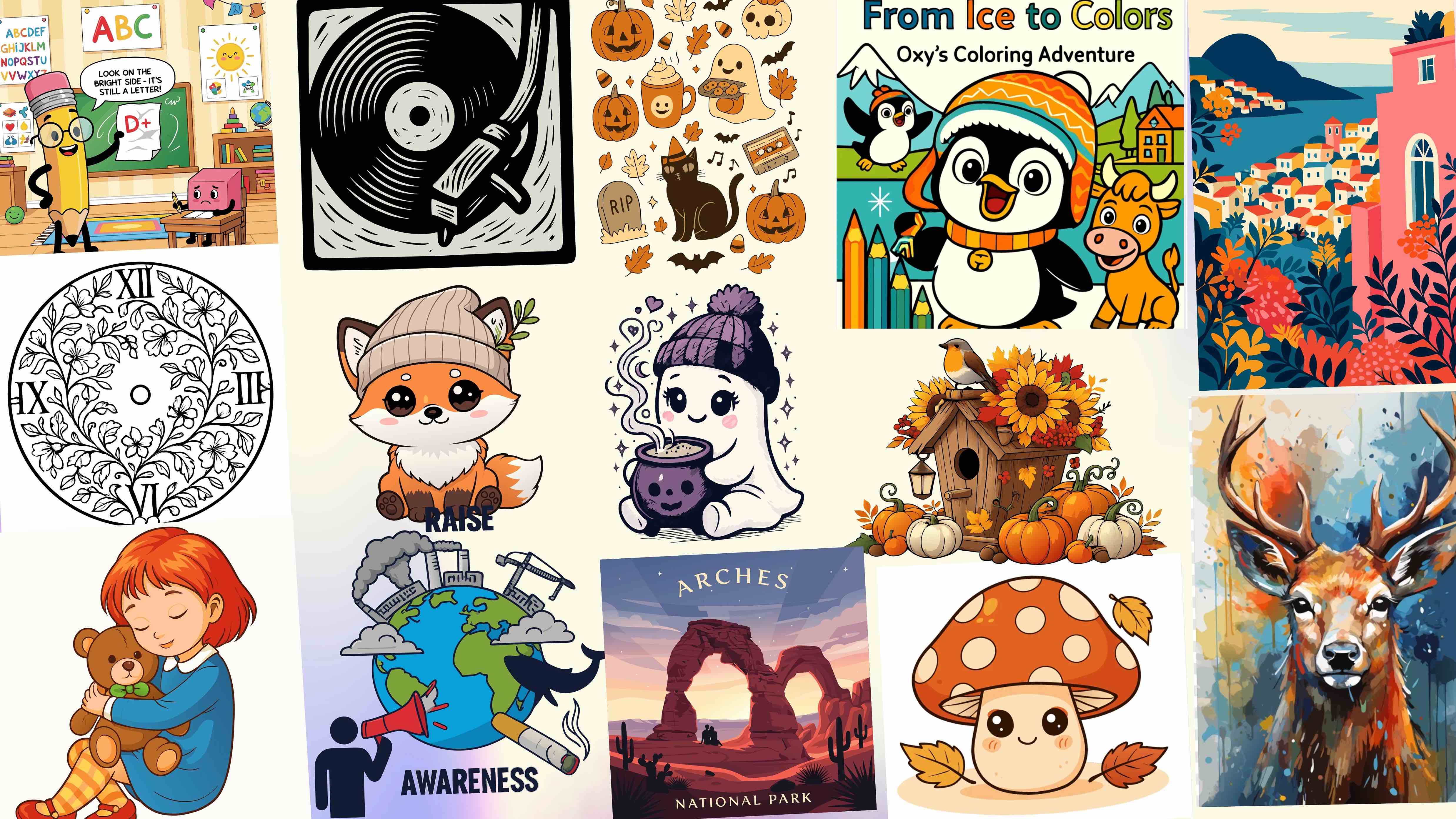
Enforcing Consistency in AI-Generated Vectors at Scale
Learn how to enforce consistency in AI-generated vectors across large design teams
Quick Navigation
Why Consistency Matters in AI-Generated Vectors
Imagine this: your design team uses an AI SVG Generation tool to create dozens of icons for a new product launch. They all look great individually. But when you place them side by side, something feels off. One icon has thicker lines than the others. Some corners are sharp, others are rounded. The spacing between elements varies just enough to look unprofessional.
This is the consistency problem with AI-generated vectors, and it gets worse as your team grows.
SVGs (Scalable Vector Graphics) are image files made from code instead of pixels. They stay crisp at any size, which makes them ideal for icons, logos, and UI elements. AI tools can generate these SVGs in seconds from a simple text prompt. But unlike a human designer who follows a style guide instinctively, AI models treat every generation as an independent task. They have no memory of what they produced before and no awareness of your brand rules.
For a single icon, this doesn't matter. For a brand system with hundreds of vectors maintained by a team of 10+ people, it's a serious problem. Inconsistent vectors make your product look disjointed, increase maintenance costs, and slow down development.
In this guide, you'll learn a practical, three-step approach to fix this:
What You'll Learn
- Define clear, measurable rules for your vectors.
- Automate enforcement using free tools.
- Add quality checks that catch issues before they ship.
Whether you're a design system lead, a frontend developer consuming SVG assets, or a solo creator building a brand, this guide is for you.
What Goes Wrong: Common Inconsistencies in AI Vectors
Before you can fix the problem of vector graphic consistency, you need to know what to look for. Here are the five most common inconsistencies in AI-generated SVGs, explained in plain language.
| Problem | What It Looks Like | Why AI Does This |
|---|---|---|
| Stroke weight varies | Some icons have thin 1px lines, others have chunky 2.5px lines | Each generation picks line thickness independently |
| Corner radii differ | One icon has sharp 0px corners, another has soft 4px rounds | AI doesn't remember your preferred rounding |
| Grid misalignment | Icons look slightly off-center or unevenly spaced when placed together | AI uses arbitrary decimal coordinates (e.g., 12.347px instead of 12px) |
| Color value drift | You asked for dark gray but get #333333, #343434, and #363636 across different icons | AI approximates colors without an exact palette |
| Decimal over-precision | Path coordinates like M 12.847362 24.193847 instead of M 13 24 | AI preserves mathematical precision that screens can't display |
Each issue alone is minor, but their cumulative effect degrades the perceived quality of your entire product. For a deep technical dive into the precision problem specifically, read our guide on solving precision challenges in AI-generated SVG code.
Step 1: Create a Simple Vector Style Guide
Think of a style guide like a recipe. Without exact measurements, every batch turns out different. Your vector style guide doesn't need to be a 50-page document. It just needs measurable rules that anyone (or any script) can check.
Here's an example style guide for an icon set:
| Property | Rule | Example Value |
|---|---|---|
| Canvas size (viewBox) | All icons use the same viewBox | 0 0 24 24 |
| Stroke weight (line thickness) | Fixed value for all icons | 1.5px |
| Corner radius (rounding) | Consistent across shapes | 2px |
| Grid unit | All coordinates snap to a grid | 0.5px increments |
| Color palette | Only approved colors | #1A1A1A, #666666, #FFFFFF |
| Decimal precision | Maximum decimal places | 2 digits max |
| Padding | Consistent inner spacing | 2px from edge |
The key is making every rule a number. "Lines should be thin" is subjective. "Stroke width must be 1.5px" is something an SVG editor online can verify.
If you're building icons for mobile apps, our guide on creating consistent SVG app icons for iOS and Android covers platform-specific rules you should add to your style guide.
Step 2: Automate Cleanup with SVGO
Checking every SVG by hand doesn't scale. That's where SVGO comes in. SVGO (SVG Optimizer) is a free, open-source tool that automatically cleans up SVG files. You configure it once, and it applies your rules to every file it processes.
Basic SVGO Configuration
Here's an svgo.config.js file that enforces common consistency rules:
Run it on all your SVGs with a single command: npx svgo -f ./icons --config svgo.config.js
Custom Plugin: Enforce Stroke Width
SVGO also lets you write custom plugins. Here's one that forces all stroke widths to your standard value:
You can write similar plugins for corner radii (rx and ry attributes) and color values. For more cleanup strategies, see our guide on five methods to clean up AI-generated SVG files and the complete SVG optimization techniques reference.
Step 3: Add Quality Checks to Your Workflow
Automation handles the fixing. Quality checks handle the catching. There are two levels here depending on your team size.
For Solo Creators: A Manual Checklist
Before you commit any SVG, check these five things:
- Does the viewBox match your standard (e.g., 0 0 24 24)?
- Is the stroke width consistent with your style guide?
- Are corner radii the same across all shapes?
- Are colors from your approved palette?
- Does the icon visually align with existing icons when placed side by side?
For Teams: Automated CI/CD Checks
CI/CD (Continuous Integration / Continuous Delivery) is a system that automatically runs checks every time someone adds code to your project. Here's a simple Node.js script that validates SVGs against your style guide:
Add this to your CI pipeline so it runs on every pull request. Any SVG that breaks the rules gets flagged before it reaches production.
For more on building automated SVG quality gates, see our guide on optimizing AI-generated SVGs for faster render times, which includes a full CI/CD section.
Use Visual Editors to Catch Issues Early
Not every problem can be caught by scripts. Sometimes you need to see the icons next to each other to spot visual inconsistencies. This is where a live SVG editor becomes valuable.
With SVG Code Editor, you can open any SVG, inspect its code, and make adjustments in real time. You can verify that stroke weights look correct visually, not just numerically. Our professional-grade advanced editing tools include path editing, boolean operations, and layer management, which make it easy to adjust individual elements to match your style guide.
If you're working with AI-generated vectors specifically, try generating through SVGMaker, then reviewing the output in the SVG editor before adding it to your project. This two-step workflow, generate then review, catches most issues before they become problems.
For teams using Figma, our comparison of which Figma plugin exports the cleanest SVG files can help you choose export tools that produce more consistent starting points.
Frequently Asked Questions
1. Can AI tools generate brand-consistent SVGs out of the box?
Not reliably. AI models generate each SVG independently with no memory of previous outputs. They don't know your brand rules unless you specify them in the prompt, and even then, the results vary. That's why post-processing and automated enforcement are essential.
2. What is SVGO and how does it help with consistency?
SVGO is a free, open-source SVG optimizer. It cleans up SVG code by removing unnecessary data, rounding coordinates, and standardizing structure. With custom plugins, you can also enforce specific rules like fixed stroke widths or color palettes.
3. What's the best SVG editor for enforcing consistency?
For automation, SVGO is the industry standard. For manual review, tools like our professional SVG Maker offer real-time editing and validation.
4. How do I make all my icons have the same corner rounding?
Set a standard rx (horizontal radius) and ry (vertical radius) value in your style guide. Then use an SVGO custom plugin to replace any rx/ry values in <rect> elements with your standard value. For example, if your rule is 2px corners, the plugin forces every rectangle to use rx="2" ry="2".
5. What stroke width should I use for icon sets?
The most common standard is 1.5px or 2px for 24×24 viewBox icons. Thinner strokes (1px) can look fragile on low-resolution screens, while thicker strokes (3px+) reduce detail in small icons. Pick one value and enforce it across your entire set.
6. How do I make sure icons align to a grid?
Define a grid unit (e.g., 0.5px) and round all coordinates to that grid. SVGO's convertPathData plugin with floatPrecision: 1 will snap coordinates to one decimal place. For pixel-perfect alignment on 24×24 icons, integer coordinates (no decimals) often work best.
7. Can I automate these checks so I don't have to do them manually?
Yes. Write a validation script (like the Node.js example above) and add it to your CI/CD pipeline. It will run automatically on every pull request and block any SVGs that don't meet your rules. This turns consistency from a manual effort into an automated guarantee.
8. What tools help check SVG consistency across a whole project?
SVGO for automated cleanup, custom Node.js scripts for rule validation, and visual tools like SVGMaker's editor for manual review. For a complete optimization workflow, see our guide on SVG optimization techniques.
Conclusion: Style Guide, Automate, Check
Enforcing consistency in AI-generated vectors comes down to three steps:
Define clear, measurable rules in a style guide.
Automate enforcement with SVGO and custom plugins.
Check with validation scripts in your CI pipeline and visual review in an editor.
You don't need to fix everything at once. Start with the biggest offenders, stroke weight and decimal precision, then gradually add rules for corner radii, colors, and grid alignment.
The goal isn't to stop using AI SVG Generation. It's to build a lightweight system around it so that every vector that reaches production looks like it belongs. With the right pipeline in place, your team gets the speed of AI generation without sacrificing the polish of a hand-crafted brand system.
For the complete picture on cleaning up AI outputs, explore our guides on AI SVG cleanup methods and optimizing SVGs for speed and performance.
Need Help?
Get support and find answers to your questions
FAQ
Find answers to frequently asked questions about SVGMaker features and functionality.
Documentation
Check the full documentation for detailed guides and tutorials.
Support
Contact support through the chatbot for personalized assistance.
Ready to enforce vector consistency?
Start creating consistent, brand-aligned SVGs with SVGMaker's AI generation and editing tools.