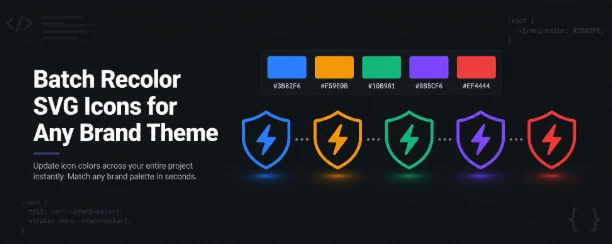
How to Batch Recolor an SVG Icon Set for Multiple Brand Themes
Quick Summary
- Most SVG recoloring problems start with fixed fill colors locked inside the SVG file — switching to currentColor solves the majority of these issues for web use.
- CSS variables and design tokens are the most scalable approach for multi-theme systems, dark mode, and white-label platforms.
- CLI tools like SVGO allow batch processing of large icon libraries without manual file-by-file editing.
- Visual SVG editors and SVG Color Editor like SVGMaker let designers and non-technical users recolor icon sets directly in the browser without writing code.
- Clean SVG file structure is the single most important factor — poorly structured files break recoloring across every method.
- The right method depends on your team's technical level, project size, and how many themes you need to support.
Why SVG Recoloring Is Harder Than It Should Be
Most SVG recoloring problems start inside the SVG file itself.
Many SVG icons use fixed fill colors. This means the color is locked inside the SVG file, making it difficult for CSS or themes to control the icon later.
A better approach is using currentColor. This allows the SVG to inherit colors directly from CSS instead of using fixed values.
| Approach | Problematic SVG | Theme-Friendly SVG |
|---|---|---|
| Color type | Fixed colors | Dynamic colors |
| Recoloring | Difficult | Easy |
| Editing method | Manual file editing | CSS-controlled |
This small structural change makes SVG theming much easier across websites and applications.
4 Methods to Batch Recolor SVG Icons
Method 1: Using currentColor for Simple Web Theming
For websites and applications, using currentColor is one of the cleanest SVG theming methods available.
Instead of editing every SVG file manually, you control icon colors directly through CSS. This creates a much faster workflow for developers and designers.
This method works especially well for:
- Website icons and navigation menus
- App interfaces
- Dark mode themes
Many developers prefer this approach because it keeps SVG files flexible and easy to maintain. It is also one of the easiest ways to change SVG color across multiple themes without repeatedly editing icon files.
Method 2: CSS Variables and Design Tokens for Multi-Theme Systems
If your project supports multiple themes or brand styles, CSS variables become very useful.
A design token is a reusable color value stored in CSS. Instead of assigning colors directly inside every SVG file, your icons use shared variables controlled by the website theme.
This method works very well for:
- SaaS dashboards
- Dark mode systems
- White-label platforms
- Multi-brand products
Instead of manually recoloring hundreds of SVG files, you update only the shared theme variables. This is one of the most scalable approaches for SVG CSS variables theming workflows.
According to the W3C CSS Custom Properties specification, CSS variables cascade normally through the document, which means a single variable change at the root level instantly propagates to every SVG element inheriting that value. This is what makes design token systems so efficient for large icon libraries.
Method 3: Batch Recoloring Large SVG Libraries with CLI Tools
Sometimes icon collections become too large for manual editing. This is where batch processing tools become useful.
Many developers use tools like SVGO and nuskin-svg. These tools allow users to process and recolor large SVG collections automatically.
Batch recoloring tools are useful for:
- Enterprise design systems
- Large icon libraries
- Updating brand colors quickly across an entire product
- Standardizing inconsistent SVG files inherited from multiple sources
This is one of the fastest ways to handle batch SVG color changes across large projects. Instead of editing icons one by one, developers can update entire libraries automatically.
For best results, ensure your SVG files are clean and consistently structured before running batch tools. SVGMaker's guide on cleaning up AI-generated SVG covers the structural cleanup steps that make batch processing more reliable.
Method 4: Visual SVG Recoloring Tools for Faster Editing
Not everyone wants to work with code. Many designers and beginners prefer visual editing tools instead.
This is where tools like SVGMaker become useful. Visual SVG editors allow users to recolor icons directly inside the browser without writing CSS or using command-line tools.
With SVGMaker's editor, users can:
- Recolor SVG icons visually
- Experiment with multiple themes quickly
- Edit SVG files without coding
- Test brand color combinations faster
This workflow is especially useful for:
- Designers working without developer support
- Marketing teams managing brand assets
- Content creators building visual systems
- Beginners learning SVG editing for the first time
For many users, this is the easiest type of SVG icon recolor workflow because it removes technical complexity and speeds up experimentation.
What About CSS Filters for SVG and PNG Icons?
Sometimes icons are loaded as image files instead of inline SVGs. In these situations, some developers use CSS filters to recolor icons.
This method can work for quick adjustments, but it has real limitations:
- Harder to control precisely
- May not match exact brand colors
- Can produce inconsistent results across browsers
CSS filters are useful for small adjustments but are not ideal for professional brand systems that require exact hex values. For exact color matching across themes, the SVGMaker workflow for generating SVGs with exact hex codes is a more reliable approach.
Which SVG Recoloring Method Should You Use?
| Workflow | Best Method |
|---|---|
| Website icons | currentColor |
| Multi-theme systems | CSS variables and design tokens |
| Large icon libraries | CLI batch tools |
| Fast visual editing | SVGMaker color editor |
| Non-technical workflows | Visual SVG editors |
There is no single perfect solution for every user. The right method depends on how much control, speed, and flexibility you need.
Common SVG Recoloring Problems and Quick Fixes
| Problem | Cause | Fix |
|---|---|---|
| Icon ignores theme colors | Fixed fill colors | Use currentColor |
| Dark mode breaks icons | Hard-coded colors | Use CSS variables |
| Colors look inconsistent | Mixed SVG structure | Standardize SVG files |
| Icons refuse recoloring | External image limitations | Use inline SVG workflows |
Most recoloring issues happen because SVG files were not prepared properly from the beginning. That is why clean SVG structure matters so much.
Why Clean SVG Structure Matters
A clean SVG file is easier to recolor, optimize, scale, and reuse across themes.
When SVG files contain unnecessary styling or inconsistent structures, recoloring becomes much harder later. This is one reason many teams now prefer workflows that simplify SVG editing early in the design process.
SVGMaker's advanced editing features, AI-powered color palette generation, multi-element color selection, and style customization tools are built around this principle, giving users clean, structured SVG output that is ready for any theming workflow from the start.
Frequently Asked Questions
1. What is the easiest way to batch recolor SVG icon sets for multiple brand themes?
It depends on your workflow. Developers often use CSS variables or CLI tools for automation. Designers and beginners usually prefer visual tools like SVGMaker because they are faster and require no coding knowledge.
2. How does a typical SVG icon recolor workflow work?
It starts by cleaning the SVG structure, removing hard-coded fill colors and replacing them with currentColor or CSS variables. After that, colors can be controlled from CSS or a visual editing tool. Batch processing tools can then update entire icon sets automatically.
3. Why do some SVG icon recolor methods fail?
SVG files with fixed colors inside the file prevent CSS from controlling icon color. Inline styles can also create conflicts with themes and dark mode systems. Cleaning the SVG structure first usually solves most recoloring problems.
4. What is the best way to change SVG color across multiple themes?
CSS variables and design tokens are the most scalable approach. A single variable change at the stylesheet level updates every icon inheriting that value, which works especially well for websites, dashboards, and multi-brand systems.
5. Can beginners change SVG colors across multiple themes without coding?
Yes. Visual SVG editors like SVGMaker allow users to recolor icons directly in the browser without touching code, making theme testing faster for designers and marketing teams.
6. What causes batch SVG color changes to break?
Inconsistent SVG file structure is the most common cause. Some files use strokes while others use hard-coded fills or inline styles, creating conflicts when applying global theme colors. Cleaning and standardizing SVG structure before batch processing prevents most of these issues.
Conclusion
Learning how to batch recolor SVG icon sets for multiple brand themes can save a huge amount of time, especially when working with large icon collections and multi-theme systems.
For developers, methods like currentColor, CSS variables, and design tokens create scalable systems that are easier to maintain long-term. For designers and beginners, visual tools simplify the process and reduce repetitive editing work.
The best method depends on your workflow, technical comfort level, and project size.
If you want a faster and more beginner-friendly way to recolor and edit SVG files, SVGMaker makes it easier to experiment with themes, adjust icon colors, and manage SVG workflows directly inside the browser.