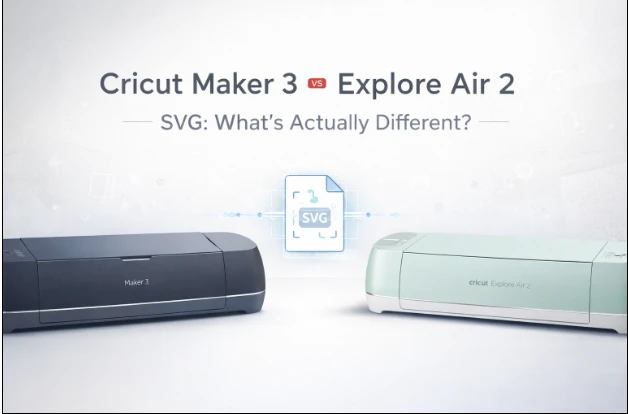
Cricut Maker 3 vs Explore Air 2 SVG: What's Actually Different?
Quick Summary
- Both Cricut Maker 3 and Explore Air 2 use the exact same SVG file format - no conversion or adjustment needed.
- The real differences are in cutting speed, material range, blade types, and maximum design size.
- Cricut Maker 3 supports over 300 materials and can cut designs up to 12 feet long with Smart Materials.
- Cricut Explore Air 2 works best with vinyl, cardstock, and paper and limits designs to around 24 inches.
- Clean, well-structured SVG files perform better on both machines, the quality of your design always plays the biggest role.
- Tools like SVGMaker help you generate machine-ready SVG files without unnecessary complexity before you upload to Cricut Design Space.
The Most Important Thing to Know First
If you are comparing Cricut Maker 3 vs Explore Air 2 SVG performance, the answer that clears up most confusion is this: there is no difference in the SVG files themselves.
Both machines use the same SVG format. You upload, edit, and prepare your designs inside Cricut Design Space in exactly the same way. There is no separate version of an SVG file for Maker 3 or Explore Air 2.
What changes is not the file. It is what each machine can do with that file once the cutting process begins.
Understanding SVG Files in Cricut
SVG stands for Scalable Vector Graphics. According to the W3C SVG specification, these files use mathematical paths rather than pixels, which means they scale to any size without losing sharpness or quality.
For Cricut users, SVG files are the preferred format because they:
- Provide precise cut paths the machine can follow accurately
- Support layered designs with multiple color sections
- Scale without any quality loss regardless of output size
- Work across a wide range of materials and project types
All SVG files compatible with Cricut Maker 3 work identically on Explore Air 2. This makes SVG one of the most flexible and interchangeable formats in the Cricut ecosystem.
Quick Comparison: Cricut Maker 3 vs Explore Air 2
| Feature | Cricut Maker 3 | Cricut Explore Air 2 |
|---|---|---|
| SVG Compatibility | Same | Same |
| Software | Cricut Design Space | Cricut Design Space |
| Cutting Speed | Up to 2x faster | Standard |
| Cutting Strength | Higher | Moderate |
| Materials Supported | 300+ | Around 100 |
| Blade Types | Rotary, Knife, Fine Point | Fine Point only |
| Smart Materials (Matless) | Yes | No |
| Max Cut Length | Up to 12 feet | Around 24 inches |
| Best For | Complex and large SVG projects | Simple and everyday projects |
| Price Range | Higher | More affordable |
The table makes one thing clear. The SVG file does not change. The machine's capabilities do.
Do SVG Files Actually Behave Differently on Each Machine?
No. Both machines read and process SVG files the same way inside Cricut Design Space. The upload process, editing tools, layout panel, and color sync options are identical across both devices.
What does vary is the final output, and that depends on:
- The material you are cutting
- The overall size of your design
- The complexity and path detail in your SVG
- The blade and tool types available on your machine
Instead of changing the file format, you adjust how you design and prepare your SVG based on what your specific machine can handle.
Where the Real Differences Show Up
Material Compatibility
Cricut Maker 3 supports a much wider range of materials, including fabric, leather, balsa wood, and thicker surfaces. This opens up more advanced design possibilities, especially when working with multi-layer projects that involve depth or dimensional structure.
Cricut Explore Air 2 delivers excellent results with vinyl, cardstock, iron-on, and paper. Within that range, it is reliable and precise. It simply does not extend into heavier or specialty materials the way Maker 3 does.
Blade Types and Design Flexibility
Cricut Maker 3 supports multiple blade types, including the rotary blade for fabric and the knife blade for thick materials like chipboard and leather. This gives you more creative range when executing detailed SVG designs.
Explore Air 2 uses a fine point blade. It is precise and dependable, but it does limit the variety of cuts you can make from a given SVG file.
If you regularly work with multi-layer SVG designs, Maker 3 gives you more room to experiment without hitting material or tool limitations.
Smart Materials and Design Size
One of the biggest practical differences between the two machines is how each handles design size.
Maker 3 supports Smart Materials, which allows matless cutting. You can run continuous designs up to 12 feet long, making it ideal for wall decals, event signage, banner text, and bulk production runs.
Explore Air 2 requires a cutting mat, which caps your usable design area at around 24 inches. If your SVG file is larger than that, you either need to resize it or split it into separate sections before cutting.
For anyone creating SVG files intended for large-format output, this is the single most important difference to plan around.
Cutting Speed and Workflow
Cricut Maker 3 cuts at up to twice the speed of Explore Air 2 when using compatible Smart Materials. For small business owners, Etsy sellers, or anyone producing designs in volume, this time saving compounds quickly across a full day of work.
Explore Air 2 cuts at a standard pace that works well for personal projects and occasional crafting. For low-volume use, the speed difference is rarely a problem.
Handling Complex SVG Designs
Both machines can open and import the same complex SVG files. Where they differ is in execution.
Maker 3 handles intricate path details and multi-layer designs more efficiently, particularly when those designs involve multiple material types or very fine cut lines.
Explore Air 2 performs best with simpler, cleaner designs. If your SVG file has very dense path data or overlapping layers, simplifying the design before cutting will improve your results.
SVG Design Tips for Each Machine
For Cricut Maker 3
| Tip | Why It Helps |
|---|---|
| Use multi-layer designs | Maker 3 handles layered complexity without issue |
| Create larger layouts | Smart Materials support up to 12-foot continuous cuts |
| Experiment with material types | Access to 300+ materials expands creative range |
| Design for production volume | Faster speed makes batch production practical |
For Cricut Explore Air 2
| Tip | Why It Helps |
|---|---|
| Keep paths clean and well-defined | Reduces cutting errors on fine point blade |
| Limit layers where possible | Simpler designs cut more consistently |
| Avoid overly intricate detail | Fine point blade has limits on tight path clusters |
| Keep designs within size limits | Mat limits design area to around 24 inches |
Common Mistakes to Avoid
Assuming the file format changes between machines. It does not. The same SVG file works on both Maker 3 and Explore Air 2 without any modification.
Overcomplicating designs for Explore Air 2. Simpler, cleaner designs almost always produce better results than pushing the machine's limits with dense path data.
Ignoring size limitations. If you design an SVG at a large format and then try to cut it on Explore Air 2, you will need to split or resize the design. Planning for size constraints before you start saves time.
Assuming output quality is purely about the machine. Your design quality and material choice play an equally large role. A poorly structured SVG will cut inconsistently on both machines.
Which Machine Is Right for Your SVG Projects?
Choose Cricut Maker 3 if you:
- Work with detailed, multi-layer, or complex SVG designs
- Use a variety of materials beyond vinyl and paper
- Create large or long-format designs regularly
- Run a small business or sell products at volume
Choose Cricut Explore Air 2 if you:
- Prefer simpler SVG projects with clean, flat designs
- Work mainly with vinyl, iron-on, and cardstock
- Are a beginner or hobby crafter with occasional use
- Focus on smaller, standard-size designs
Creating Machine-Ready SVG Files
Before any design goes through a Cricut Design Space SVG upload, preparation is what separates clean cuts from problem cuts. Clean paths, properly structured layers, and correctly scaled designs make the cutting process smoother on both machines.
This is where SVGMaker fits into the workflow. You can generate SVG designs from a text prompt using the AI generator, refine them visually in the SVG editor, and export clean, optimized files that are ready for Cricut without unnecessary path complexity.
For users converting existing images into Cricut-compatible SVG files, the photo-to-SVG converter and sketch-to-SVG tool handle the vectorization before upload, so what goes into Cricut Design Space is already clean and properly structured.
You can also review SVGMaker's guide on SVG optimization for more detail on preparing files for cutting machines, and explore how to make SVG files for Cricut for a step-by-step walkthrough.
Frequently Asked Questions
1. Do Cricut Maker 3 and Explore Air 2 use the same SVG files?
Yes. Both machines use the exact same SVG files. The variation between machines is in how they cut, not in what file format they accept.
2. Is there any difference in SVG handling between the two machines?
No. The SVG upload, editing, and preparation process inside Cricut Design Space is identical for both machines.
3. Can I reuse SVG files across different Cricut machines?
Yes. SVG files are fully interchangeable across Cricut machines. You can switch between devices without modifying your designs.
4. How does Cricut Design Space SVG upload work?
You import the SVG file directly into the software. Once uploaded, you can resize, recolor, and arrange your design on the virtual canvas before sending it to your machine for cutting.
5. Why is my SVG not cutting correctly after upload?
The issue is almost always with the design file itself rather than the machine. Cleaning up paths, reducing unnecessary nodes, and simplifying layers typically resolves cutting errors.
6. Which machine is better for multi-layer SVG projects?
Cricut Maker 3 is better suited for multi-layer projects because it supports more material types and handles intricate designs more efficiently than Explore Air 2.
Final Thoughts
When it comes to Cricut Maker 3 vs Explore Air 2 SVG compatibility, the file format is not what sets these machines apart. Both accept the exact same SVG files, and both process them through Cricut Design Space in the same way.
The real decision comes down to what you plan to cut, how large your designs are, and how often you produce. Maker 3 is the stronger choice for complex, multi-material, and large-format work. Explore Air 2 remains a solid option for beginners, hobbyists, and users who stick to vinyl, iron-on, and paper-based projects.
Whichever machine you choose, the quality of your SVG file is what shapes the final result. Clean, well-prepared designs cut better, waste less material, and produce more consistent output. Tools like SVGMaker help you get there faster by generating and refining Cricut-ready SVG files without the complexity of traditional design software.