Creating Your First SVG
Learn how to generate your first SVG from a text prompt and customise it to your needs.
Quick Navigation
Introduction
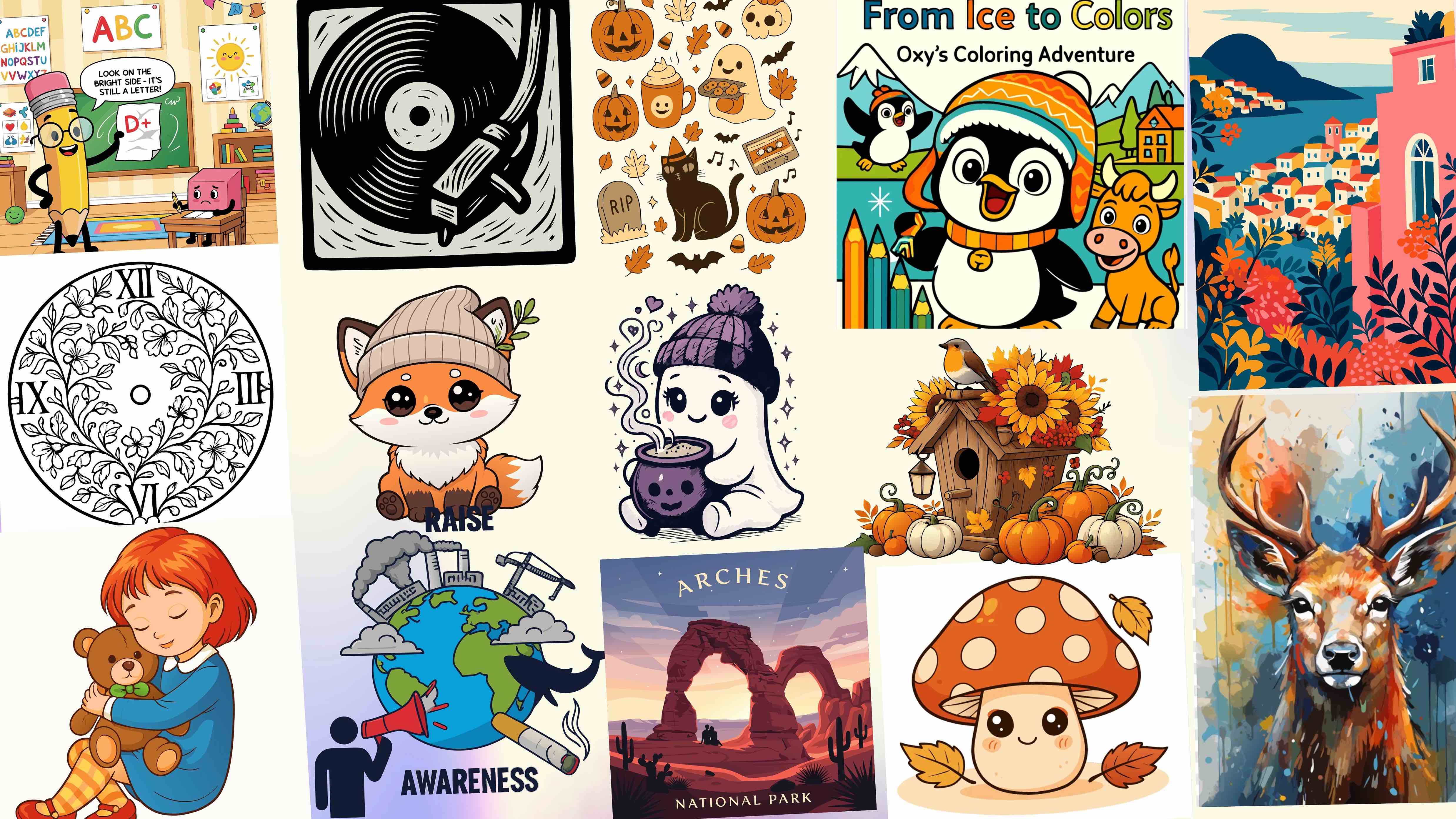
SVGMaker AI-powered generation and SVG Editor lets you create professional vector graphics in seconds — no design experience required.
What You'll Learn:
- How to write effective prompts for SVG generation
- Understanding style options (artistic style, colour mode, complexity)
- Using the Generate interface step-by-step
- Customising aspect ratio and quality settings
- Downloading and sharing your SVG
Why Generate SVGs with AI
Creating vector graphics traditionally requires design software expertise and significant time investment. AI-powered SVG generation changes this entirely.
Speed
Generate professional SVGs in seconds, not hours.
No Design Skills Needed
Describe what you want in plain language.
Infinite Scalability
Vector output stays crisp at any size.
Consistent Quality
Get polished results every time.
Easy Iteration
Refine and regenerate until it's perfect.
Common Use Cases:
- Custom icons for websites and applications
- Illustrations for blog posts and articles
- Logo concepts and brand graphics
- Social media graphics and banners
- Presentation visuals and infographics
- Educational diagrams and charts
Understanding the Interface
Before we dive into creating your first SVG, let's familiarise ourselves with the main elements of SVGMaker's generation interface.
Prompt Input Area
The central text area where you describe the SVG you want to create. The more descriptive you are, the better your results.
Enhance Button
AI-powered feature that expands your simple prompt into a more detailed description for better generation results.
Style Options
Dropdowns to fine-tune visual characteristics: Artistic Style, Colour Mode, Complexity, Composition, and Text settings.
Aspect Ratio
Choose from common ratios like 1:1 (Square), 3:2 (Landscape), 2:3 (Portrait).
Quality Settings
Select between Low, Medium, and High quality, or manually choose specific AI models for generation.
Style Options Breakdown
- Artistic Style — The overall visual approach (Flat, Line Art, Isometric, etc.)
- Colour Mode — How colours are applied (Full Colour, Monochrome, Few Colours)
- Complexity — The level of detail (Icon, Illustration, Scene)
- Composition — How elements are arranged (Centred, Pattern, Full Scene)
- Text — Whether to include text elements (No Text, Only Title, Embedded Text)
Step-by-Step Generation Guide
Follow these steps to create your first SVG:
Go to SVGMaker - Visit the homepage or open SVGMaker directly.
Select the Generate tab - Make sure you're in Generate mode (not Edit or Convert).
Enter your prompt - Type a clear description of the SVG you want to create in the text area.
Enhance your prompt (optional) - Click the Enhance button to let AI expand your description for better results.
Choose your style - Select an Artistic Style from the dropdown (e.g., Flat, Line Art, Isometric).
Set colour preferences - Pick a Colour Mode that matches your needs.
Select complexity - Choose whether you want an Icon, Illustration, or Scene.
Adjust aspect ratio - Click the aspect ratio selector and choose your preferred dimensions.
Click Generate - Press the Generate button to start creating your SVG.
Wait for the result - The AI will process your request and display the generated SVG.
Download or refine - Save your SVG or enter Edit mode to make further changes.
Tip
Start simple. For your first SVG, try something straightforward like "a rocket ship icon" or "a coffee cup illustration" to see how the system works before tackling more complex requests.
Writing Effective Prompts
The quality of your prompt directly affects the quality of your output. Here's how to write prompts that get great results.
What Makes a Good Prompt
Be Specific
Instead of "a dog", try "a friendly golden retriever sitting, cartoon style, simple lines"
Include Context
Mention the intended use — "icon for a mobile app" or "hero illustration for a landing page"
Describe Style Elements
Add details about colours, mood, or visual style — "warm sunset colours", "minimal geometric shapes"
Prompt Examples
| Poor Prompt | Better Prompt |
|---|---|
| A tree | A single oak tree with autumn leaves, flat design, orange and brown colours |
| House icon | A simple house icon with chimney, minimal line art style, suitable for a real estate app |
| Logo | A circular emblem with a mountain peak and rising sun, modern geometric style, blue and gold colours |
| Cat | A cute sleeping cat curled in a ball, cartoon style, soft pastel colours, simple shapes |
Using the Enhance Feature
The Enhance button is your secret weapon for better prompts:
Tip: Even experienced users benefit from Enhance. It often adds creative details you might not have considered.
Understanding Style Options
Choose the right combination of styles for your specific needs.
Artistic Styles
| Style | Best For | Description |
|---|---|---|
| Flat | Icons, UI elements, modern graphics | Clean, simple shapes with solid colours and no gradients |
| Line Art | Minimalist designs, sketchy aesthetics | Outline-based graphics with emphasis on strokes |
| Engraving | Vintage, classic, certificate designs | Detailed line work mimicking traditional engraving techniques |
| Linocut | Bold, artistic, print-style graphics | High contrast with a hand-carved woodblock appearance |
| Silhouette | Simple icons, dramatic visuals | Solid shapes without internal detail |
| Isometric | Technical, 3D-style, infographics | Pseudo-3D projection at a fixed angle |
| Cartoon / Playful | Fun, friendly, child-oriented content | Exaggerated features with bright, bold colours |
| Ghibli | Whimsical, artistic, nature themes | Soft, painterly style inspired by Studio Ghibli animation |
Colour Modes
- Full Colour
Complete colour palette with gradients and variety
- Monochrome
Single colour with varying shades and tones
- Few Colours
Limited palette (typically 2-4 colours) for a cohesive look
Complexity Levels
- Icon
Simple, recognisable symbols (best for app icons, UI elements)
- Illustration
Moderate detail with clear subject matter
- Scene
Complex compositions with multiple elements and backgrounds
Composition Options
- Centred object
Single subject in the middle, ideal for icons and logos
- Repeating pattern/tile
Seamless patterns for backgrounds and textures
- Full scene
Complete compositions with backgrounds and multiple elements
- Objects In Grid
Multiple related items arranged in a grid layout
Note
Not every option needs to be set. Start with just an artistic style and let the AI make smart choices for other settings.
After Generation
Once your SVG is ready, you have several options for what to do next.
View and Inspect
Your generated SVG appears in the result display.
Download Options
Save as SVG (Vector), PNG, JPG, or WebP. Choose from multiple resolutions and optimization levels.
Edit and Refine
Not quite right? Click Edit to use natural language: "Make the background blue", "Remove the text", "Add a shadow".
Save & Share
Sign in to save to your account or share to the public gallery for others to discover.
Troubleshooting Common Issues
Solutions for common problems you might encounter.
Result doesn't match my prompt
- Make your prompt more specific and descriptive
- Try using the Enhance button
- Check if a specific style option is overriding your intentions
- Regenerate — AI results vary
SVG looks too simple
- Increase complexity from Icon to Illustration or Scene
- Add more details to your prompt
- Try a different artistic style, like Cartoon or Ghibli
SVG is too complex
- Switch to Icon complexity
- Use Flat or Silhouette style
- Add 'minimal' or 'simple' to your prompt
Colours aren't what I expected
- Specify colours explicitly in your prompt
- Use Monochrome or Few Colours mode
- Try Flat style for cleaner colour output
Generation failed or timed out
- Check your internet connection
- Try a shorter, simpler prompt
- Ensure you have sufficient credits
- Contact support if the issue persists
Need Help?
Get support and find answers to your questions
FAQ
Find answers to frequently asked questions about SVGMaker features and functionality.
Documentation
Check the full documentation for detailed guides and tutorials.
Support
Contact support through the chatbot for personalized assistance.
Ready to create your first SVG?
Start generating professional vector graphics in seconds with SVGMaker's AI.